
Life-Cycle Assessment in the Wine Industry
Publication Year
2025
Original Title
Life-Cycle Assessment in Agri-Food Systems and the Wine Industry—A Circular Economy Perspective
Orginal Author(s)
Catarina Marques; Sinem Güneş; Alice Vilela; Reinaldo Gomes
Original Organisation
University of Trás-os-Montes and Alto Douro (CITAB/Inov4Agro and CQ-VR); Dokuz Eylül University; INESC TEC
Keywords
Life-cycle assessment · circular economy · agri-food systems · resource efficiency · waste valorisation · wine industry
Summary
This open-access review examines the role of Life-Cycle Assessment in supporting more sustainable agri-food systems from a circular economy perspective. It reviews 102 studies selected from an initial set of 174 identified through searches of Scopus, Web of Science and Google Scholar. The review considers environmental impacts, resource optimisation, waste valorisation and the relationship between food and wine production within broader agri-food systems.
The authors argue that LCA can provide actionable information for eco-design, resource recovery and policy development, but that future assessments should better account for social and regional differences, uncertainty, consumer behaviour and the full food-system life cycle.
Key insights
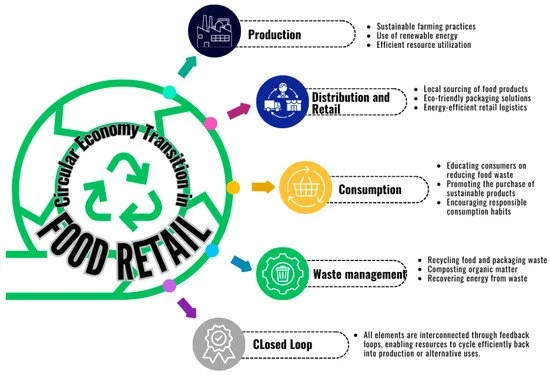
Figure 1. Circular economy in food retail. Marques et al. (2025), Foods 14(9), 1553, CC BY 4.0.
1. Life-Cycle Assessment can identify environmental hotspots across the food-system life cycle, from resource use and production to consumption and waste management.
2. Combining LCA with circular economy principles can support resource efficiency, waste reduction, by-product valorisation and more sustainable production practices.
3. Circular strategies highlighted in the review include renewable energy, precision agriculture, nutrient recovery and the conversion of agri-food by-products into useful resources.
4. In wine production, major environmental hotspots include viticulture inputs, fermentation and primary packaging, particularly glass bottles.
5. The authors identify important limitations in current LCA approaches, including data gaps, regional variability, inconsistent system boundaries and limited integration of social and economic dimensions.